My introduction to Honolulu’s Kaka’ako neighborhood was hard and fast, and I liked it. On arrival, I was immediately ushered into cocktail-centric and appropriately named Bevy to clink Lilikoi-whiskey cocktails and other fruity concoctions––like, within a half hour of landing. I smelled like airplane and my hair had already begun to frizz from the island humidity. I didn’t care. I was surrounded by family, new friends, good drinks and the island intonation I hadn’t heard in nearly two years––and easily slipped back into during the seven days I was home.

Kaka’ako

Kaka’ako is trendy yet local; friendly, inviting and casual. It is the island lifestyle elevated, yet it seems the fun I had while visiting is just the beginning of a 15-20 year plan to revitalize the area, according to Our Kaka’ako. Backed by Kamehameha Schools, the intent for a walkable, live, work, play environment with ample green space is already evident in the handful of small eateries and watering holes that dot the cross streets of Ala Moana Boulevard.

A pint at Honolulu Beerworks.

Read the rest of this entry »

IMG_5652
Lebanese food in Brussels

Given the strength of Europe’s obvious culinary powerhouses like Paris and Barcelona (and practically the entire country of Italy, it seems), Brussels may not immediately jump to mind as a foodie destination. But, there’s more to the city’s food scene than Belgian (not French! As is the common refrain in the city) frites and waffles, as I learned during a recent trip with Visit Brussels.

Case in point, the Lebanese feast we tore through in the Ixelles neighborhood that was one of the most memorable meals of the brief, four-day visit. Think creamy hummus, beets, greens and yogurt-based condiments to drizzle or dollop over it all. Don’t forget the pita, and generous pours of Lebanese wine (my first taste).

Eat, converse, imbibe, repeat. It was glorious. And then the meat course came, and for that I was…not prepared. I should have slowed my roll with the hummus!

And yet, the smell of perfectly charred meat––chicken, lamb, whatever––is painful to resist.

Other culinary moments included stopping for Pasteis de Nata (yes, more than one) in between Art Deco and Art Nouveau tours, amusing myself over Brussels’ “Perfect Egg” dish obsession (like the city’s avocado toast, it seemed like the appetizer was everywhere) and stumbling into chocolate mousse by the scoop near Grand Place, a UNESCO World Heritage site.

IMG_5659
You can’t go to Brussels and not have chocolate.

In short, would return, highly recommend and next time, I’m hitting up some of these dishes.


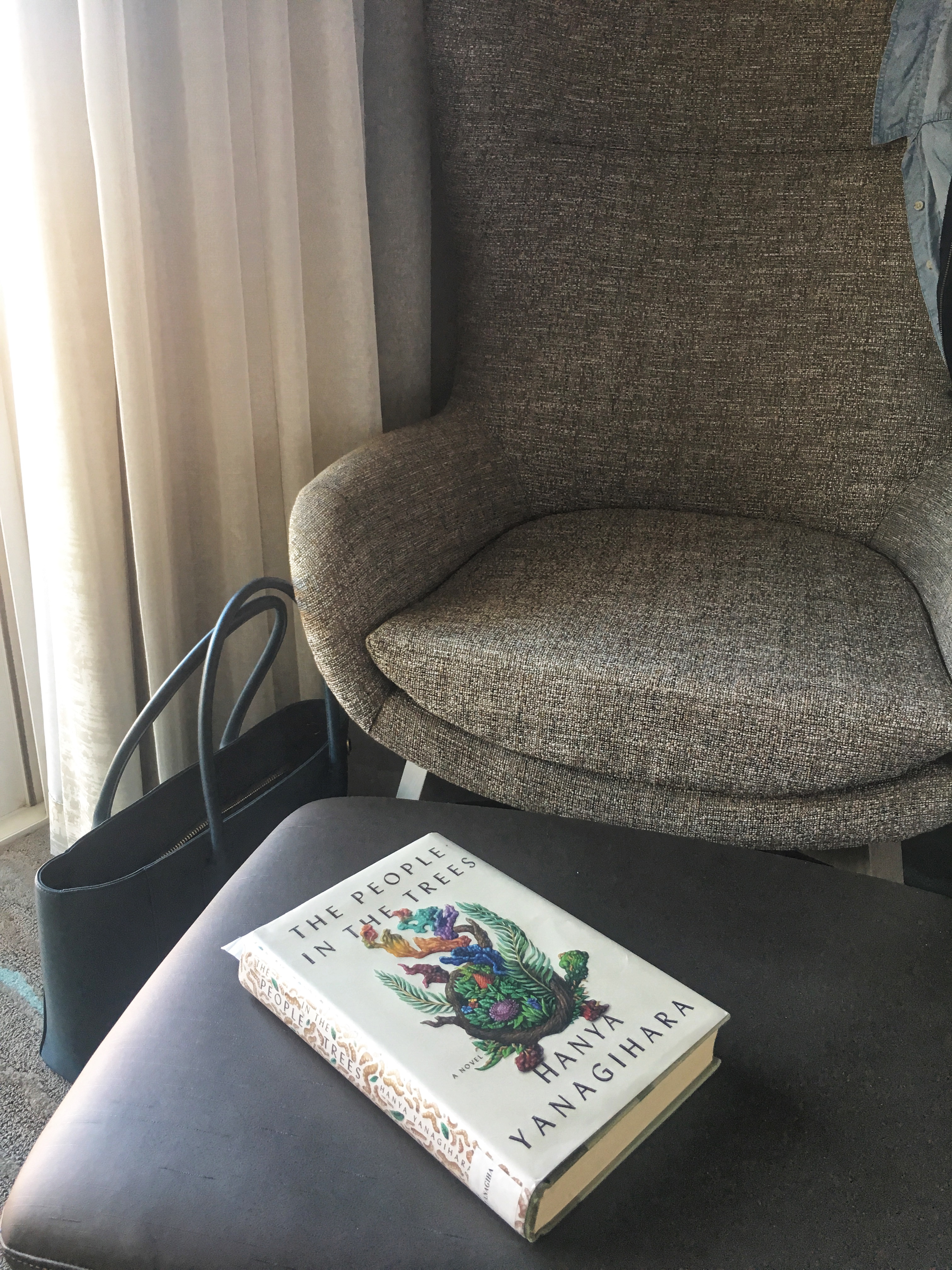
What I'm Reading: The People in the Trees

The People in the Trees* is a story about what happens when the quest for immortality unravels humanity’s dark side. It is also a story about what happens when cultures clash; or when one culture imposes itself on another to detrimental consequences.

In Hanya Yanagihara’s novel, the story is told as scientist Norton Perina’s memoir. Perina, our protagonist, discovers a fountain of youth during an anthropological excursion on a remote, thickly forested island in Micronesia. The golden ticket: a special turtle the native population eat when they reach a certain age.

Unfortunately, vitality of body does not equally mean vitality of mind. Those who eat this special turtle live far beyond the normal lifespan, and while the body keeps up physically the mind deteriorates with time.

We follow Perina through discovery, ambition, recognition and a moral reckoning he – and we – must grapple with.

Language runs longer than concise and footnotes throughout – which are annotated by Perina’s friend (lover?!) – read academic, with lots of scientific citations and tangential anecdotes that paint a picture of Perina’s meteoric career and the savory (and not so) characters in his orbit.

Yanagihara’s novel is a literary adventure, and a timely read given current conversation about globalization, the me too movement and environmental concerns.

Read this book to lead your moral compass through its acrobatic paces. The author poses these questions, in an interview with Vogue,

“It’s so easy to affix a one-word description to someone, and it’s so easy for that description to change: if we call someone a genius, and then they become a monster, are they still a genius? How do we assess someone’s greatness: is it what they contribute to society, and is that contribution negated if they also inflict horrible pain on another? Or—as I have often wondered—is it not so binary?”

For further reading from Polynesia, check out this insider’s travel guide to Honolulu I wrote for New York magazine or this essay about the breakfast plate in Hawaii that unlocks its multicultural history, for Food 52.

*Some links are affiliate links, which mean that if you sign-up or purchase I may get some perks, but all opinions and product selections are my own.